The modern university experience often feels like a non-stop sprint. Between back-to-back lectures, part-time jobs, and the social pressure to be constantly “active,” the academic portion of life—specifically essay writing—frequently becomes a source of frantic, last-minute stress. We have been taught that speed is a virtue and that pulling an all-night session fueled by caffeine is a rite of passage. However, this “hustle culture” is increasingly leading to burnout and mediocre grades. There is a better way to navigate the pressures of higher education: the Slow Living movement.
Slow Living isn’t about being lazy or moving at a snail’s pace; it is about intentionality. It is about choosing quality over quantity and presence over pressure. When applied to academics, it means starting early, researching deeply, and allowing ideas to marinate. For many undergraduates struggling to find this balance, seeking professional essay help from experts like MyAssignmentHelp can be the first step in reclaiming their schedule. By outsourcing the heavy lifting of formatting or initial drafting, students can focus on actually absorbing the material rather than just surviving the deadline.
The Problem with the “Fast Academic” Mindset
In a digital world, we are conditioned to expect instant results. This mindset translates poorly to the world of academia, where complex thought requires time and cognitive “breathing room.” When students rush an essay, they skip the most vital part of learning: the synthesis of information. Instead of connecting dots, they are merely repeating facts to fill a word count.
This frantic approach doesn’t just hurt the grade; it hurts the student’s well-being. High cortisol levels from constant deadline-induced stress can impair memory and creativity. By adopting a slow approach, you shift the focus from “getting it done” to “getting it right.” This transition allows for a more profound connection with the subject matter, making the degree feel like a journey of discovery rather than a series of hurdles.
Intentional Research: The Foundation of Slow Writing
A slow living approach to essays starts long before the first word is typed. It begins with the research phase. Instead of grabbing the first three sources on Google Scholar, a “slow” student explores the library, reads full chapters instead of just abstracts, and takes handwritten notes. This physical act of slowing down helps the brain process information more effectively.
During this phase, it is also helpful to look for topics that resonate on a personal level. For instance, when looking for inspiration for sociology or psychology papers, exploring curated lists of family essay topics provided by MyAssignmentHelp can help you find a narrative that feels authentic to your own life. When you write about something that matters to you—like family dynamics or heritage—the process feels less like “work” and more like an exploration of self.
How to Implement “Slow Living” in Your Study Routine
Transitioning to this lifestyle requires a structural change in how you view your week. It involves setting boundaries with your technology and your peers. It means saying “no” to a social event because you want to spend a quiet evening at a local cafe or a cozy cottage setting, deeply immersed in a single book.
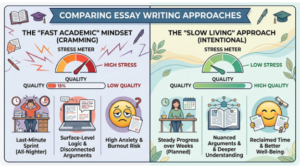
| Aspect of Writing | The “Fast” Way (Stressful) | The “Slow” Way (Productive) |
| Topic Selection | Picked at random 2 days before. | Chosen early based on personal interest. |
| Research | Skimming abstracts for quotes. | Deep reading and cross-referencing. |
| Drafting | One long, panicked session. | Short, focused bursts over two weeks. |
| Editing | Run through a basic spellchecker. | Read aloud; peer or professional review. |
| Outcome | High stress, surface-level logic. | Low stress, nuanced argumentation. |
Finding Balance Through Assistance
One of the biggest misconceptions about being a “serious” student is that you must do everything entirely alone. In the professional world, the most successful people are those who know how to delegate tasks to specialists. The same applies to university. If you are overwhelmed by a specific technical requirement or a massive pile of research, using a service is a way to “slow down” the rest of your life.
By utilizing support for the more mechanical parts of writing, you create the space needed to focus on your core modules. This isn’t a shortcut; it’s a resource management strategy. It allows you to maintain your “Slow Living” philosophy even when the academic calendar gets crowded, ensuring that your mental health remains a priority alongside your GPA.
The Environment: Your Study Sanctuary
Where you work is just as important as how you work. The “Slow Living” philosophy encourages us to curate our environments. Instead of a cramped, messy desk in a noisy dorm, try to find a space that inspires calm. Natural light, a clean surface, and perhaps a view of nature can significantly lower your heart rate and improve your focus.
If you have the opportunity to study in a rural setting—perhaps a weekend trip to a quiet cottage—you’ll find that the lack of urban distraction allows for “Deep Work.” This is the state where the best academic breakthroughs happen. In these moments of stillness, the complex arguments for your essay often click into place without the need for forced effort.
Conclusion: Quality as a Lifestyle
Ultimately, your time at university is about more than a piece of paper; it is about developing the way you think and interact with the world. By rejecting the “fast-food” version of education and embracing a slower, more deliberate pace, you produce work that has true substance. You become a student who doesn’t just pass exams but understands the world on a deeper level.
Take a breath, start your next assignment a week earlier than usual, and allow yourself the luxury of time. You might find that the essay you once dreaded becomes the project you are most proud of.
Frequently Asked Questions (FAQ)
1. Does “Slow Living” mean I will miss my deadlines?
Ans: Quite the opposite. By starting earlier and working in intentional increments, you usually finish well before the deadline, avoiding the “danger zone” of the final 24 hours.
2. Is it okay to use professional help for my essays?
Ans: Yes. Seeking guidance or structural support from services like MyAssignmentHelp is a common way for students to manage high workloads and learn better academic writing techniques by example.
3. How do I find interesting topics for my assignments?
Ans: Look for themes that connect to your personal life or current global issues. Using resource lists, such as those for family essay topics, can give you a head start in finding a subject that keeps you engaged.
4. What if I don’t have a “quiet cottage” to study in?
Ans: You don’t need a literal cottage to practice slow living. A quiet corner of a public library, a park bench, or even using noise-canceling headphones in a coffee shop can help you create a mental sanctuary.
5. How long should a “Slow” study session be?
Ans: Research suggests that 60 to 90 minutes of “Deep Work” followed by a 15-minute break away from screens is the most effective way to maintain high-level cognitive function.
About The Author
I am Ella Thompson, a Senior Academic Consultant at MyAssignmentHelp with over a decade of experience helping undergraduate students navigate the complexities of higher education. My professional focus lies at the intersection of academic excellence and mental well-being, advocating for a “Slow Living” approach to studies that prioritizes deep learning over last-minute cramming.